
Develop the strategic judgment to read complex professional environments, understand power and influence, navigate conflict, regulate responses under pressure, and make deliberate decisions with greater awareness of context, consequences and responsibility.
0
117
Created by
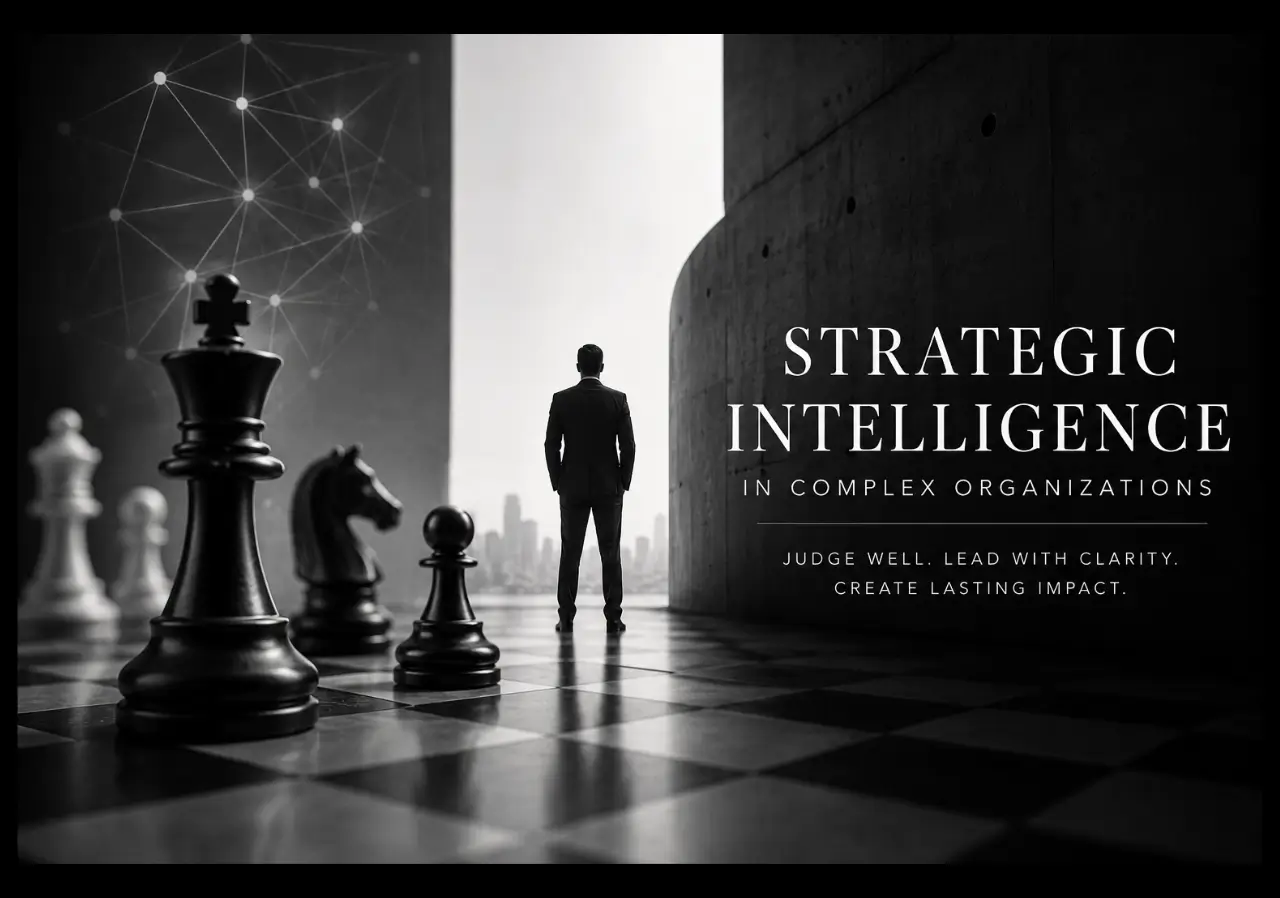
Power, Influence & Decision-Making in Complex Organizations
Designed for: Managers · Leaders · Entrepreneurs · Consultants · Senior Professionals · Project Leaders · Business Owners · Professionals Moving into Positions of Greater Responsibility
Learning Outcomes
By the end of this course, you should be able to:
- distinguish observation, interpretation, assumption and evidence in complex professional situations;
- identify relevant actors, interests, incentives, dependencies, constraints and competing priorities;
- map formal authority, informal power and the mechanisms through which influence actually operates;
- regulate reactions under pressure so emotion, ego, urgency and status do not distort decision quality;
- use listening, questions, silence, disclosure and timing as deliberate components of strategic communication;
- diagnose conflict, negotiating power, boundaries and concessions with greater precision;
- evaluate reputation, trust, visibility and informal authority as accumulated organizational evidence;
- make decisions under ambiguity by examining trade-offs, reversibility, second-order consequences and ethical legitimacy;
- integrate these dimensions into a Strategic Situation Map for a real professional challenge.
Course Description
Professional environments are shaped by more than organizational charts, formal authority and technical competence. Decisions are also influenced by interests, incentives, relationships, information, reputation, dependencies, informal authority and competing priorities.
Strategic Intelligence is an advanced professional development course designed to strengthen the ability to understand these dynamics before deciding how to act.
The course explores how professionals can read complex environments, recognize formal and informal power structures, interpret behavior without confusing assumptions with facts, regulate responses under pressure, communicate with greater strategic awareness, navigate conflict, negotiate effectively and protect long-term professional credibility.
Rather than teaching formulas such as “speak less,” “never reveal your intentions,” or “choose your battles,” the course examines when different behaviors become strategically appropriate — and when the same behaviors can create unintended consequences.
Participants will work with realistic professional situations involving competing interests, ambiguous information, organizational politics, reputation, boundaries, conflict and difficult decisions. They will learn to examine not only the immediate outcome of an action, but also its relational, reputational, organizational and ethical consequences.
A central element of the course is the development of strategic judgment: the ability to distinguish observation from interpretation, understand what is actually at stake, identify relevant actors and dependencies, evaluate alternatives and choose deliberate responses rather than acting primarily from impulse, pressure or ego.
Throughout the learning experience, concepts are connected to practical analysis through professional scenarios, decision exercises and structured frameworks designed to develop a more sophisticated understanding of how organizations and professional relationships actually operate.
Strategic Intelligence is not about manipulating people or accumulating power over others. It is about developing the analytical, behavioral and relational intelligence required to operate responsibly and effectively in complex professional environments.
Its central principle is simple:
Before deciding what to do, understand what is actually happening.
Course Currilcum
-
- What Strategic Intelligence Really Means FREE 00:45:00
- Why Competence Is Not Enough 00:45:00
- Observation, Interpretation and Assumption 00:50:00
- From Reaction to Strategic Choice 00:50:00
- Foundations of Strategic Intelligence — Assessment 00:15:00
-
- Organizations as Human Systems 00:50:00
- Actors, Interests and Incentives 00:55:00
- Dependencies, Constraints and Competing Priorities 00:55:00
- Reading Signals Without Overinterpreting Them 00:55:00
- Reading the Organizational Environment — Assessment 00:15:00
- How Power Actually Works in Organizations 01:00:00
- Formal Authority vs. Informal Power 01:00:00
- Expertise, Information, Networks and Dependency 01:05:00
- Influence Without Manipulation 01:05:00
- Power Architecture & Ethical Influence — Assessment 00:15:00
- Listening as Strategic Intelligence FREE 01:05:00
- Information: What to Share, When and With Whom 01:05:00
- Silence, Questions and Strategic Timing 01:05:00
- Speaking When Silence Becomes a Liability 01:05:00
- Strategic Communication — Assessment 00:15:00
- Reputation as Accumulated Evidence 01:10:00
- Consistency, Reliability and Professional Trust 01:05:00
- Visibility, Recognition and the Politics of Credit 01:07:00
- Building Influence Without Performing Power 01:10:00
- Reputation, Trust & Informal Authority — Assessment 00:15:00